
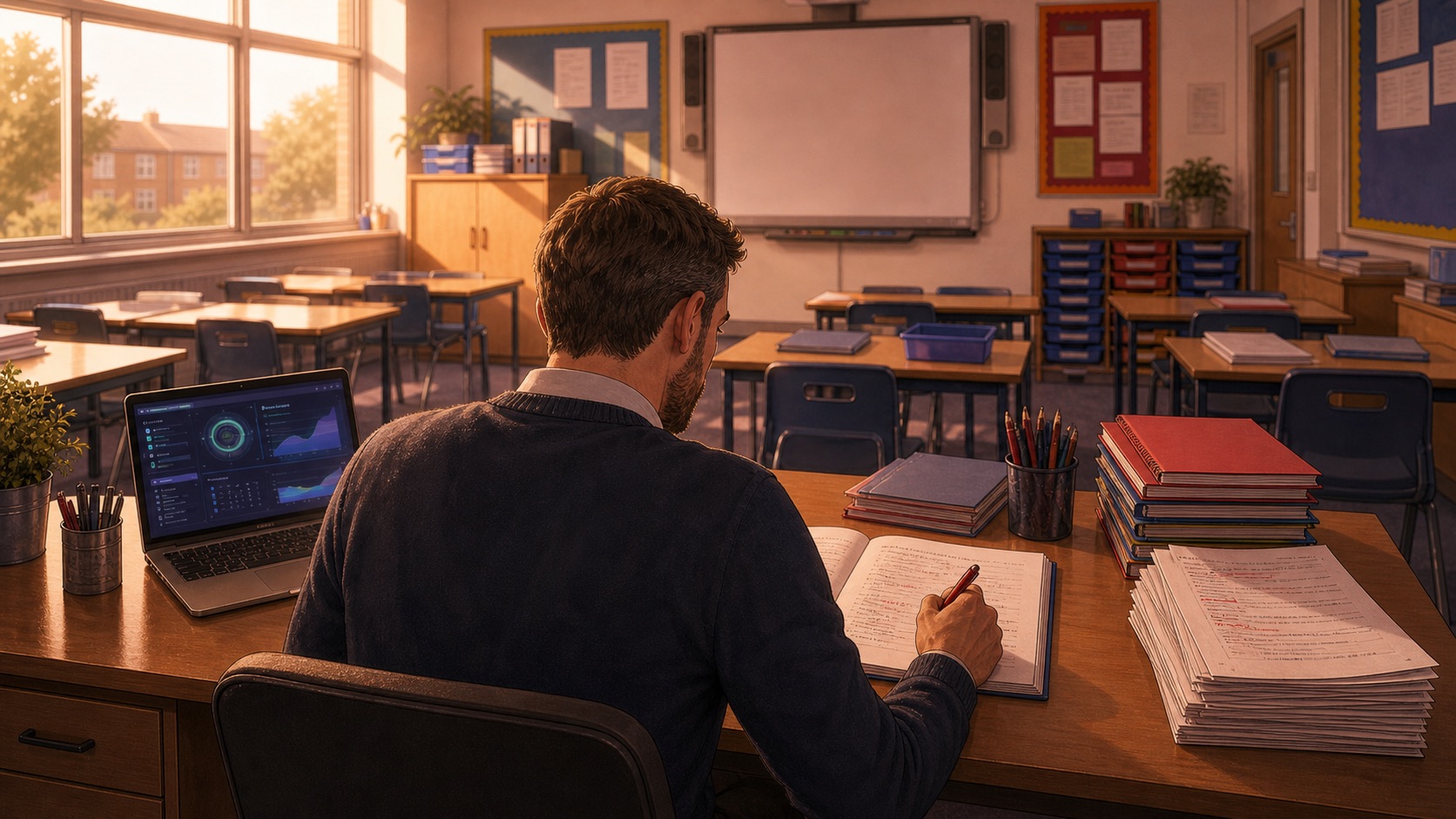
There is a particular kind of silence that settles over a school after the pupils have gone. The corridors empty. The photocopier finally stops complaining. Somewhere, a classroom clock ticks with the quiet menace of work still unfinished. On a desk sits the familiar pile: exercise books, essays, assessments, mock papers, scripts that represent hours of pupil effort and, very often, hours more of teacher attention.
For years, marking has been one of the great contradictions of teaching. It is essential, but often exhausting. It is where we meet pupils' thinking most closely, but it can become the thing that pulls us furthest away from planning, teaching and being present. Every teacher knows the feeling of writing "develop this further" for the twenty-third time and wondering whether the comment is feedback, evidence, performance, habit, or simply survival.
So when artificial intelligence arrives and promises to read work, summarise strengths, identify errors and suggest feedback in seconds, it is not hard to understand the appeal. For teachers, it sounds less like a futuristic revolution than a long-overdue dishwasher. Not glamorous. Not magical. Just a machine that might finally take some of the heavy, repetitive labour out of professional life.
And perhaps it can.
The Department for Education's current guidance recognises that generative AI may support tasks such as tailored feedback, revision activities, resource creation and administrative work. It also identifies workload reduction as one of the possible benefits, while warning that AI outputs can be inaccurate, biased, unreliable, out of context or low quality. In other words, the promise is real, but so is the risk. AI may help teachers move faster, but speed is not the same as judgement.
AI may help teachers move faster, but speed is not the same as judgement.
This distinction matters because marking is not merely the act of placing a number beside a piece of work. It is an act of interpretation. A good teacher does not simply see that a paragraph is weak. They see that Hannah has remembered the quotation but not understood its significance. They notice that Amir's argument is improving, even though his spelling has slipped. They know that Ellie's work looks brief because she was anxious, not because she was idle. They hear the lesson in the script.
AI can process the text. It cannot know the child.
That is not an argument against using it. It is an argument against pretending it is doing the same thing as a teacher.
The strongest case for AI in marking is not that it can replace teacher feedback, but that it can protect the conditions in which better human feedback becomes possible. Used well, it might act like a sharp, tireless teaching assistant sitting beside the pile of books. It can flag a recurring misconception. It can suggest which pupils may need a follow-up question. It can draft a comment that the teacher then edits into something precise, humane and usable. It can help a department see patterns across a class before those patterns harden into gaps.
This aligns with what we already know about effective feedback. The Education Endowment Foundation has repeatedly emphasised that feedback is powerful not because information is collected, but because teachers act on what pupils show them. A 2025 EEF piece describes feedback as the "engine" of adaptive teaching: the process by which teachers notice pupil signals, interpret them and decide what should happen next.
That is the heart of the issue. Feedback is not a document. It is a loop.
The pupil produces something. The teacher notices something. The teacher responds. The pupil thinks again. The loop continues. Sometimes this happens in a written comment. Sometimes it happens in a question at the desk. Sometimes it happens when the teacher stops the lesson after seeing six mini whiteboards with the same misconception and says, "Right, we need to go back."
AI can help us notice. It can even help us phrase. But it cannot complete the loop on its own, because the loop is relational. It depends on professional knowledge, trust, timing and context.
Human responsibility is the principle, not the paperwork
This is where policy becomes more than compliance. The Joint Council for Qualifications is clear that, where centres allow AI tools to help mark student work, an AI tool cannot be the sole marker. A human assessor must review the work in full and remains responsible for the mark or grade awarded. This is not a technical footnote. It is the whole principle. The teacher is not there to rubber-stamp the machine. The machine is there, if used at all, to assist the teacher.
The same guidance also reminds centres that clear records should be kept where AI use has affected final marks or grades, especially for appeals, moderation or standards verification. That may sound bureaucratic, but it is really about trust. If a pupil asks why they received a particular mark, the answer cannot be "the platform decided". If a parent questions feedback, the school must be able to explain the professional judgement behind it. If a piece is moderated, the evidence trail must show that assessment integrity has not been outsourced.
For leaders, this means the question is not whether staff are "using AI". Many already are, in some form. The more urgent question is whether the school has a shared language for safe, professional use.
In a sensible school workflow, AI should usually sit at the draft stage, not the decision stage. It might be used to generate a first pass of feedback, but not the final comment without teacher review. It might compare a response against success criteria, but not award a mark without human assessment. It might identify common strengths and weaknesses across a class, but not label a pupil's ability, effort or potential.
The line is simple enough to write, but harder to maintain under pressure. AI should support professional judgement, not conceal its absence.
Children's work is still children's data
There is also the matter of data. Schools do not only hold work. They hold children's work. That work may include names, personal experiences, SEND-related information, safeguarding concerns, medical references, family circumstances and the small, revealing details that make school writing so human. DfE guidance recommends that personal data is not used in generative AI tools, and notes that many free tools may use submitted inputs to train or refine their models. It also states that schools and colleges must not allow students' original work to be used to train generative AI models without permission or a relevant exception.
This is where the metaphor of the dishwasher breaks down. A dishwasher does not learn from the plates. AI tools may learn from what we feed them, unless the product, contract and settings say otherwise. That means leaders need to know exactly which tools are approved, what data is entered, whether work is anonymised, how long it is stored, and whether pupil content is being used for model training.
A school AI marking policy should therefore be less like a poster that says "Be careful with AI" and more like a practical traffic system. Green routes. Amber routes. Red routes. Staff should know which kinds of tasks are safe, which require approval and which are prohibited. Low-stakes formative feedback on anonymised work may sit in one category. NEA, coursework, formal assessment and identifiable pupil data sit somewhere far more sensitive.
Ofqual's 2026 resources on AI and coursework make this particularly urgent. They stress that AI-generated coursework submitted as a pupil's own is malpractice, and that schools need a whole-school approach so staff and pupils hear consistent messages. Ofqual also emphasises that when AI does the work, students do not learn, and qualifications lose their meaning because they no longer signal what a student can actually do.
That same logic should shape our approach to marking. If AI does too much of the thinking for the teacher, something is also lost. The grade may still exist. The comment may still be grammatically polished. The spreadsheet may look impressively complete. But the teacher's understanding of the pupil may have thinned.
The danger of feedback that belongs to no one
This is the quiet danger of automation in education. Not that it fails loudly, but that it succeeds superficially. It produces the thing that looks like feedback. It produces the paragraph, the target, the next step. But the teacher may not have had to think deeply about the work, and the pupil may not feel that anyone has really seen it.
Teachers know the difference. So do pupils.
A pupil can tell when a comment belongs to no one. It has that smooth, scented-candle quality of generic praise: "You have made a good attempt and should develop your analysis further by using more evidence." It is not wrong. It is just weightless. It floats above the work rather than entering it.
Human feedback has texture. It might be shorter. It might even be messier. But it often lands because it carries knowledge of the pupil. "Your argument is much clearer than last time, but you are still describing the evidence before explaining why it matters." That sentence does more than correct. It remembers. It places today's work inside a story of improvement.
This is where AI-generated feedback must be edited until it sounds like a teacher, not because we are trying to hide the use of a tool, but because pupils deserve feedback with intent. The aim is not to make AI sound human for the sake of appearances. The aim is to make feedback useful, specific and accountable.
A good test for AI-assisted feedback is this: would I say this to the pupil? Would they know what it means? Would it help them improve? Could I defend it as my judgement?
If the answer is no, it is not ready.
AI can reduce labour, but not responsibility
Leaders also need to protect staff from a false economy. It is tempting to imagine that AI marking will instantly save hours. Sometimes it will. But safe use requires time too: time to anonymise, check, edit, moderate, challenge, record and reflect. If schools present AI as a magic workload solution, staff may either distrust it or overuse it. The more honest message is better: AI can reduce some forms of labour, but it does not remove professional responsibility.
This matters especially in formal assessment. The JCQ guidance is clear that teachers and assessors must be assured that work accepted for assessment is the student's own. It recommends approaches such as supervised completion, checking intermediate stages, setting reasonable deadlines and examining whether final work is a natural continuation of earlier drafts.
These are not new ideas. They are old truths made newly urgent. In a world where fluent text can appear instantly, schools need to value the process of thinking, not just the product of writing. Drafts matter. Conversations matter. Planning notes matter. Oral questioning matters. The teacher's knowledge of the pupil matters.
AI should push us back towards better assessment design, not towards more suspicion. The answer is not to turn every classroom into an airport security queue. It is to create assessment conditions in which authentic thinking is easier to see.
The better future keeps the teacher in the loop
There is a leadership opportunity here. Schools can use AI as a reason to revisit what feedback is for. Not marking for evidence. Not marking for performance. Not marking as ritual sacrifice to the accountability gods. Feedback as information that changes what happens next.
That might mean using AI to help a history department identify that half of Year 11 can recall causes but cannot weigh significance. It might mean using it to summarise common misconceptions after a science assessment so the next lesson begins in the right place. It might mean using it to draft three possible feedback questions for a pupil whose answer is nearly there, but not quite.
The human teacher still decides. The human teacher still speaks. The human teacher still knows when to ignore the machine.
That may be the best analogy for AI in assessment: not a replacement driver, but a satnav. It can suggest a route. It can warn about traffic. It can recalculate quickly when the road changes. But a good driver still looks out of the windscreen. They notice the cyclist the satnav cannot see. They slow down near the school gate. They know when the fastest route is not the safest one.
So it is with marking. AI can offer directions. It cannot carry the duty of care.
The future of AI in feedback should not be a cold one. It should not be a world where pupils submit work into a system and receive machine-polished comments from nowhere. Nor should it be a world where teachers, already stretched thin, are told to ignore tools that could genuinely help.
The better future sits between panic and surrender.
It is a future where teachers use AI to see patterns sooner, but not to avoid reading. Where leaders approve tools carefully, but do not smother innovation. Where departments moderate AI-assisted feedback openly, so staff learn together. Where pupils are taught that AI can support thinking, but cannot substitute for it. Where assessment remains a claim about what a young person can do, not what a machine can produce on their behalf.
Above all, it is a future where the teacher remains in the loop.
Not as a token human at the end of an automated process. Not as a signature beneath a machine's judgement. But as the person who brings context, ethics, subject knowledge and care to the work in front of them.
AI can read the essay.
Only the teacher can read the moment.
And in education, the moment is often where the learning begins.